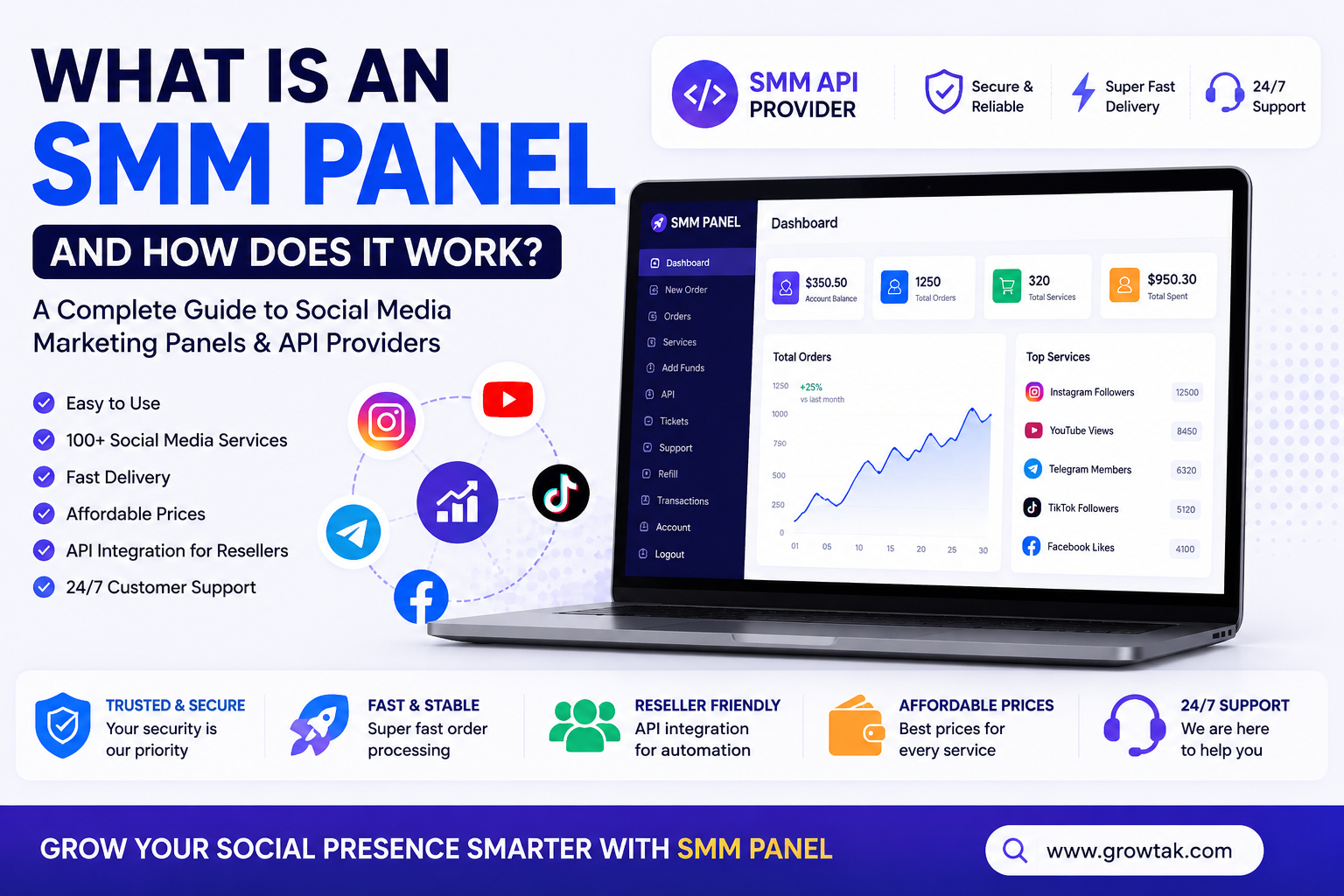
What Is an SMM Panel? The Complete 2026 Guide for Buyers & Resellers
SEO META (for your CMS, not part of the published body): Title Tag: What Is an SMM Panel? The Complete 2026 Guide for Buyers & Resellers Meta Description: Confused about SMM panels and SMM API providers? Here's a clear, no-fluff guide to how they work, who uses them, and how to pick one that won't waste your money. Suggested Slug: /what-is-an-smm-panel-guide Primary keyword: smm panel Secondary keywords: smm api provider, best smm panel, smm reseller panel, cheap smm panel -->
What Is an SMM Panel? The Complete 2026 Guide to Buying Social Media Growth the Smart Way
A few years ago, growing on social media meant one thing: post, wait, hope. Today it means something else entirely. Behind a huge chunk of the followers, views, and likes you see online, there's a quiet industry working in the background — and it's called the SMM panel.
If you've ever typed "buy Instagram followers" or "cheap YouTube views" into Google, you've already brushed up against this world without realizing it. This guide breaks down what an SMM panel actually is, how the order you place actually gets fulfilled, who's really using these platforms in 2026, and — more importantly — how to tell a panel worth your money from one that will quietly waste it.
So, What Exactly Is an SMM Panel?
SMM stands for Social Media Marketing. An SMM panel is simply a website where you can buy social media engagement — followers, likes, views, comments, subscribers, shares, watch time — for platforms like Instagram, YouTube, TikTok, Facebook, Telegram, Twitter/X, Spotify, and LinkedIn.
Think of it less like a marketing agency and more like a vending machine for engagement. You log in, pick a service, paste a link, choose a quantity, and pay. No phone calls, no contracts, no waiting on a freelancer to get back to you. The whole thing is built to be self-serve.
That simplicity is exactly why the model exploded. A small creator with no marketing budget and a mid-sized agency managing twenty client accounts can use the exact same panel — just at very different volumes.
How an Order Actually Moves Through the System
This part is where most explanations get either too vague or too dry, so here's the honest, practical version.
When you place an order on an SMM panel, you're not actually buying directly "from" that website in most cases. You're buying from a storefront that's connected, behind the scenes, to one or more suppliers — these are usually called SMM API providers or "main providers." The panel itself rarely produces the engagement; it routes your order to whoever can deliver it.
Here's what that journey looks like in practice:
You create an account and load your balance — usually through UPI, cards, crypto, or a wallet. You search for the service you need (say, "Instagram Reel Views") and you'll often see several tiers at different prices, because quality and delivery speed vary even within the same category. You paste your link, set your quantity, and confirm the order.
From there, the panel's system pings its connected API provider automatically. If that provider has stock, your order starts moving — sometimes within seconds, sometimes after a short queue. The panel dashboard updates your order status in real time: pending, in progress, partially completed, or completed. Good panels also show you the start count, so you can actually verify the service is real and not just a green checkmark on a screen.
The entire chain — your click, the panel's routing, the API provider's delivery — usually takes minutes, not days. That speed is the whole selling point.
SMM Panel vs. SMM API Provider: Why People Mix These Up
This trips up almost everyone new to the space, so it's worth untangling properly.
An SMM panel is the customer-facing storefront. It's the website you log into, the dashboard you see, the support ticket you open if something goes wrong. Most panels you find by searching are this layer.
An SMM API provider is the supplier behind that storefront. It doesn't usually deal with individual retail customers directly — instead, it gives panel owners API access so their site can place orders automatically, at scale, without a human approving each one.
A main provider sits one level deeper still — it's the original source that actually has the infrastructure to deliver the service, rather than reselling someone else's stock.
In plain terms: you → panel → API provider → (sometimes) main provider. Each layer adds a small markup, which is why the cheapest panel isn't always buying from the most reliable source — sometimes it's just absorbing a thinner margin from a shaky supplier.
If you're a reseller rather than a one-time buyer, this distinction matters a lot, because your panel's reliability is only ever as good as the API provider feeding it.
Who's Actually Buying From SMM Panels Right Now
The stereotype is that this is purely a vanity-metrics game for people chasing follower counts. The reality in 2026 is more layered than that.
Creators and influencers use panels less to fake an audience and more to clear the early "cold start" problem — the awkward phase where good content gets buried because the algorithm hasn't decided you're worth pushing yet. A realistic early boost can sometimes nudge that decision.
Small businesses and local brands lean on panels for social proof. A storefront with 40 followers looks abandoned even if the products are great; a storefront with a healthy-looking presence gets the benefit of the doubt from a first-time visitor.
Agencies managing multiple client accounts use panels as one tool among many — combined with actual content strategy and paid ads, not as a replacement for them.
Resellers are an entirely different category. They're not buying engagement for themselves at all — they're building their own branded panel on top of an API provider's infrastructure and selling to the first three groups.
It's worth being honest about something here: every major platform's terms of service technically prohibit purchased engagement, and enforcement has gotten sharper, particularly around fake accounts and bot-driven views. None of that means the industry has shrunk — if anything it's grown — but it does mean how you buy (drip-fed, gradual, realistic-looking) matters a lot more than it used to.
The Real Benefits — and What Nobody Tells You
The upside is genuinely real. Panels are inexpensive compared to running ads, the variety of services is enormous, and for someone managing several accounts, having everything in one dashboard saves serious time. API integration means a reseller can process thousands of orders without lifting a finger after setup.
But there are trade-offs that most "Top 10 SMM Panel" listicles conveniently skip.
Quality varies wildly between providers selling the exact same service name. "1000 Instagram Followers" from one panel might be real, gradually-delivered accounts; the same listing from another panel might be low-quality bot accounts that get purged in a platform cleanup within weeks, taking your numbers — and the money you spent — down with them.
Speed can backfire. An account that goes from 200 to 20,000 followers overnight looks suspicious to both platform algorithms and actual humans who land on the profile. Gradual delivery, even if it's slightly more expensive, tends to hold up better and looks far more natural.
And refill policies matter more than people expect. Engagement naturally drops off over time as inactive or flagged accounts get removed — a panel with genuine refill protection will top your order back up during a guarantee window; one without it just leaves you to watch the number quietly shrink.
How to Actually Vet a Panel Before You Pay
Skip the marketing copy and check these instead.
Look at the start count behavior on a small test order before committing to anything large — does it move the way the dashboard claims it will? Check whether the panel publishes drip-feed options, since that single feature does more for the safety of an order than almost anything else on this list. Read the refill window in actual terms (7 days? 30? Lifetime?) rather than just seeing the word "refill" and assuming it's generous. See if support responds to a real question before you've paid them anything — a panel that goes quiet pre-sale will almost certainly go quiet if your order fails. And if you're evaluating it as a reseller, ask directly which API provider sits behind it, because that single relationship determines almost everything about your future uptime.
The single biggest mistake people make is comparing panels purely on price per 1,000 followers. That number is the easiest thing to manipulate and the worst predictor of whether you'll actually get what you paid for.
Thinking About Building Your Own SMM Reseller Panel?
This is where the model gets genuinely interesting from a business standpoint, because the barrier to entry is lower than almost any other online business.
The rough path looks like this: pick a stable SMM API provider as your backend, set up your own branded panel (there are ready-made scripts for this, or custom builds for more control), connect the API so orders flow automatically, set your own pricing on top of the wholesale rate, wire up a payment gateway, and start bringing in customers.
The part people underestimate is everything after setup. A reseller panel succeeds or fails on reliability and support, not on having the lowest prices on the internet. Undercutting every competitor by a few cents while your API provider has frequent outages is a fast way to burn through your first hundred customers. Margins matter less than retention in this business — a customer who trusts your panel will keep coming back monthly; one who got a failed order on day one almost never does.
Where This Is Heading
A few shifts are worth watching going into the rest of 2026. Platforms have gotten noticeably better at detecting unnatural growth patterns, which is pushing the whole industry toward slower, more realistic-looking delivery as the new standard rather than a premium add-on. Watch time and retention-based services (rather than raw view counts) are becoming more valuable as platforms shift their own algorithms to reward genuine engagement over surface numbers. And reseller competition has intensified enough that support quality and uptime, not price, are increasingly what separates panels that last from ones that disappear in a year.
None of this replaces an actual content strategy — it never did. The panels that survive long-term are the ones being used as a supplement to real growth efforts, not a substitute for them.
Frequently Asked Questions
Is using an SMM panel against the rules?Most platforms' terms of service technically prohibit purchased engagement, though enforcement varies by platform and by how the order is delivered. Gradual, realistic delivery carries meaningfully less risk than instant, obviously-bulk delivery.
Why do prices vary so much between panels for the same service?Quality, delivery speed, and which API provider sits behind the panel. The cheapest option is often cheap because it's sourcing from a less reliable supplier.
What does "refill" actually mean?If your follower or like count drops within a set window (the refill period), the provider tops it back up at no extra cost — provided the panel actually honors that policy.
Can I run an SMM panel without coding experience?Yes. Most reseller panels are built on existing scripts or white-label platforms, so the technical lift is mostly configuration rather than development from scratch.
Should I use more than one panel for the same account?Generally no — splitting orders for the same link across multiple panels at the same time tends to create irregular delivery patterns that are easier for platforms to flag.
Final Word
An SMM panel isn't a shortcut that replaces good content — it's a tool, and like any tool, the result depends entirely on how carefully you use it. Vet the provider behind the storefront, favor gradual delivery over instant numbers, and treat refill and support quality as more important than the price tag. Done that way, it's a genuinely useful piece of a much bigger growth strategy — not the whole strategy itself.
Related Articles
🔹 What is an SMM Panel Guide
https://growtak.com/blog/what-is-an-smm-panel-and-how-does-it-work
🔹 Best SMM API Provider for Resellers
https://growtak.com/blog/best-smm-api-provider-for-resellers
🔹 Cheapest SMM API Provider
https://growtak.com/blog/cheapest-smm-api-provider
🔹 View All Services
🔹 Contact GrowTak
https://growtak.com/contact-us